Dosing
Administration
OJEMDA is the only once-weekly oral targeted therapy in R/R pLGG1
The recommended dosage of OJEMDA is 380 mg/m2 taken orally once weekly
Convenient once-weekly oral dosing
Available as a tablet and as an oral suspension
Taken with or without food
- The recommended dosage of OJEMDA is based on BSA, and should not exceed 600 mg
- Tablets are recommended for BSA ≥0.9 m2 unless oral suspension is clinically indicated
- A recommended dosage for patients with BSA <0.3 m2 has not been established
- The oral suspension formulation of OJEMDA is strawberry flavored, and can be administered either through an oral dosing syringe or feeding tube
- Continue to treat until disease progression or intolerable toxicity
Once-weekly oral dosing offers the possibility of fewer daily interruptions in children’s and families’ lives
Information on missed doses with OJEMDA
If a weekly dose of OJEMDA is missed by
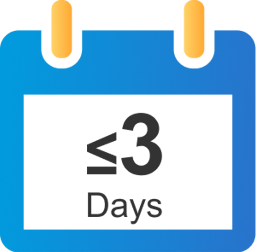
- The missed dose should be taken as soon as possible
- The next dose should be taken on the regularly scheduled day
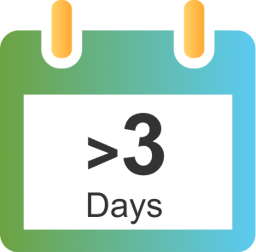
- The missed dose should be skipped
- The next dose should be taken on the regularly scheduled day
If vomiting occurs immediately after taking a dose, the dose should be repeated.
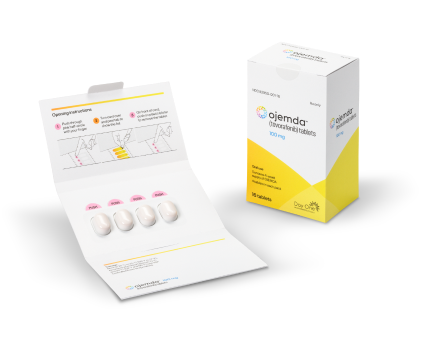
Tablets should be swallowed whole with water. The tablets should not be chewed, cut, or crushed.
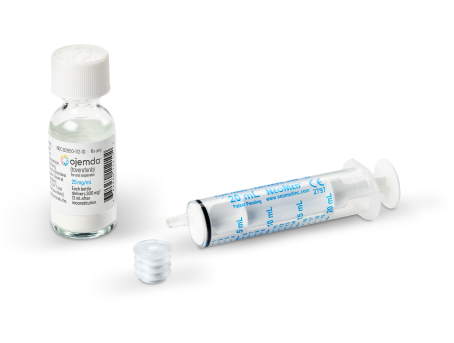
Ensure that caregivers and patients read and understand the “Instructions for Use” before preparing, measuring, and administering OJEMDA.
Images of products not actual size.
For your patients and caregivers preparing the liquid dose of OJEMDA
Download Oral Suspension Instructions

Watch: How to prepare a liquid dose of OJEMDA
Hi, I’m Melissa. My daughter, Sawyer, lives with pediatric low-grade glioma or pLGG. This video is a guide for preparing and giving a liquid dose of OJEMDA. You’ll see actors in the tutorial, but real pLGG caregivers like me helped Day One make this video to reflect authentic moments. Creating a routine can help incorporate a weekly treatment like OJEMDA into your family’s schedule.
You could pair your weekly OJEMDA dose with a routine like Sunday morning pancakes. Enjoy the video.
When your child first starts on OJEMDA, have their care team walk you through the steps before preparing the dose at home. This will ensure you get answers to any questions you may have.
In addition to this video, the EveryDay Support From Day One team can schedule a video counseling session with a pharmacist to help you walk through the process as a practice round.
Always give OJEMDA exactly how your child’s care team tells you. Is your child’s dose more than 12 milliliters? Or given using a feeding tube? You can find instructions in your Step-by-Step Guide or on OJEMDA.com/step-by-step.
This process consists of 4 simple steps:
PREP | MIX | FILL | GIVE
“Prep” is our first step. To start, clear off and clean a flat surface. Then, wash and dry your hands.
As you prepare the dose, remember—timing is important. Once prepared, OJEMDA must be taken within 15 minutes, or the medicine will start to thicken. When you’re ready, be sure you have everything you need. From the OJEMDA box, you’ll have:
- A 20 milliliter syringe
- A bottle adapter
- And bottle of OJEMDA powder
You’ll also need:
- A timer—this is super important! You could use the timer on your smartphone.
- A clean cup filled with room-temperature water
As you go, it might be helpful to have the OJEMDA Step-by-Step Guide handy.
Next, pick up the syringe. Pull the plunger up to the top of the syringe and push it back down to remove all the air inside.
Place the tip of the syringe into the water. Pull the plunger up to draw in exactly 14 milliliters of water regardless of your child’s prescribed dose. This will make sure the mixture has the right concentration.
Next, turn the syringe up to check for large air bubbles. Small air bubbles are OK. Large air bubbles are not OK. If you see large air bubbles like these, push on the plunger to release them. Then carefully add water back in so you have 14 milliliters. Repeat this step until there are no large air bubbles. Then set your syringe aside.
After we have our syringe prepped, we can move on to our next step: “Mix.”
Open the bottle by firmly pushing down on the cap and twisting. Set the bottle cap aside and remove the seal. Don’t throw away the cap, you’ll need it later on.
While holding the bottle in place, carefully inject all 14 milliliters of water from the syringe into the bottle. Twist the cap back on the bottle, and set a timer for 60 seconds.
Shake the bottle for 60 seconds in all directions. Be sure to shake it up well! Turn the bottle upside down to make sure there are no clumps of powder stuck to the bottom of the bottle. If you see some powder, shake for 15 seconds at a time until the powder is fully mixed. But make sure you do this no more than 2 minutes total. Use your timer to keep track.
If you still see powder after 2 minutes, contact your child’s pharmacist, care team, or your Patient Navigator at EveryDay Support From Day One and ask for a replacement bottle.
Next, set the timer for 30 seconds and swirl the bottle upside down. Open the bottle to check that no clumps are stuck to the bottle neck or under the cap. If you see clumps of powder in the bottle, put the cap back on the bottle, turn it upside down, and swirl for another 15 seconds. Then, let the bottle sit for 60 seconds.
The mixture may have a lot of foam at first, but letting it sit for a minute allows most of it to settle. Next, open the bottle, take your bottle adapter, and press it firmly into the bottle. The top of the bottle adapter should be even with the top of the bottle.
Let’s move onto our third step, “Fill.”
Take your syringe and draw air to your child’s prescribed dosage. For example, if your child’s prescribed dose is 12 milliliters, you would draw the syringe back to the 12 milliliter mark. Push the entire tip of the syringe into the bottle adapter. With the syringe still in the adapter, hold the bottle at the neck and swirl for 30 seconds. Swirling helps to make sure you get any excess powder that’s stuck in the neck of the bottle mixed in.
Force the air from the syringe into the bottle, and keep pushing the plunger down. This will make it easier to draw the liquid medicine into the syringe. Then, with the syringe still in the bottle and the plunger pushed down, flip it upside down.
Fill the syringe to the prescribed dose amount. Before removing the syringe, check for any air bubbles. To remove them, slowly push some of the medicine back into the bottle. If necessary, draw in more medicine to reach the prescribed dose.
Next, while holding the plunger in place, carefully turn the bottle upright and put it down. Hold the bottle and remove the syringe by gently pulling it straight up.
We’ve made it to the last step, “Give.”
Before giving the medicine to your child, check the syringe to make sure that the right amount of the dose is in the syringe. Make sure your child is sitting upright when taking their dose of OJEMDA.
Give your child the syringe if they are able to take the medication on their own. If not, place inside your child’s mouth, against the inside of their cheek to prevent a gag reflex.
Slowly push the medicine into your child’s mouth. Remember, your child can eat or drink before or after taking their dose.
And if 2 bottles are required to give your child their full prescribed dose, follow the same instructions using the second bottle to give the rest of the dose.
Clean-up is easy!
Once you’re done, throw away all of the used supplies, including the medicine bottle, adapter, and syringe in the trash. When you’re giving OJEMDA, just remember the 4 steps: prep, mix, fill, and give.
INDICATION
What is OJEMDA™ (tovorafenib)?
OJEMDA is a prescription medicine used to treat certain types of brain tumors (cancers) called gliomas in patients 6 months and older:
- that is a pediatric low-grade glioma (LGG), and
- that has come back after previous treatment or has not responded to previous treatment and
- that has a certain type of abnormal “BRAF” gene.
IMPORTANT SAFETY INFORMATION
Before taking or giving OJEMDA, tell your healthcare provider about all of your or your child’s medical conditions, including if you:
- have bleeding, skin, or liver problems
- are pregnant or plan to become pregnant. OJEMDA can harm your unborn baby.
Females who are able to become pregnant:
- You should use effective non-hormonal birth control (contraception) during treatment with OJEMDA and for 28 days after your last dose of OJEMDA.
Males with female partners who are able to become pregnant should use effective non-hormonal birth control (contraception) during treatment with OJEMDA and for 2 weeks after your last dose of OJEMDA.
- are breastfeeding or plan to breastfeed. Do not breastfeed during treatment and for 2 weeks after your last dose of OJEMDA.
Tell your healthcare provider about all the medicines you take, including prescription and over-the-counter medicines, vitamins, and herbal supplements.
What should I avoid while taking OJEMDA?
Limit the amount of time you spend in sunlight. OJEMDA can make your skin sensitive to the sun (photosensitivity). Use sun protection measures, such as sunscreen, sunglasses and wear protective clothes that cover your skin during your treatment with OJEMDA.
What are the possible side effects of OJEMDA?
OJEMDA may cause serious side effects, including:
- bleeding problems (hemorrhage) are common and can also be serious. Tell your healthcare provider if you develop any signs or symptoms of bleeding, including:
- - headache, dizziness or feeling weak
- - coughing up blood or blood clots
- - vomiting blood or your vomit looks like "coffee grounds"
- - red or black stools that look like tar
- skin reactions, including sensitivity to sunlight (photosensitivity). OJEMDA can cause skin reactions that can become severe. Tell your healthcare provider if you get new or worsening skin reactions, including:
- - rash
- - bumps or tiny papules
- - acne
- - peeling, redness, or irritation
- - blisters
- liver problems. Your healthcare provider will do blood tests to check your liver function before and during treatment with OJEMDA. Tell your healthcare provider right away if you develop any of the following symptoms:
- - yellowing of your skin or your eyes
- - dark or brown (tea-colored) urine
- - nausea or vomiting
- - loss of appetite
- - feeling tired
- - bruising
- - bleeding
- - pain in your upper right stomach area
- slowed growth in children. Growth will be checked routinely during treatment with OJEMDA.
The most common side effects of OJEMDA include:
- rash
- hair color changes
- feeling tired
- viral infection
- vomiting
- headache
- fever
- dry skin
- constipation
- nausea
- acne
- upper respiratory tract infection
OJEMDA may cause fertility problems in males and females, which may affect your ability to have children.
These are not all the possible side effects of OJEMDA. Call your healthcare provider for medical advice about side effects. You may report side effects to the FDA at 1-800-FDA-1088.
Please see full Patient Information, including Instructions for Use, for more information.
Find the support you need to get your patients started with OJEMDA
See OJEMDA resources

Dosage Modifications
Dosage modifications for OJEMDA vary across adverse event grades
Recommended dosage modifications of OJEMDA for adverse reactions
Severity of ADR*
Dosage
modification
| Hemorrhage |
|---|
Intolerable grade 2 Withhold OJEMDA.
|
First occurrence of any grade 4 Withhold OJEMDA.
|
Recurrent grade 4
|
| Skin toxicity including photosensitivity |
Intolerable grade 2 Withhold OJEMDA.
|
| Hepatotoxicity |
Grade 3 AST or ALT Withhold OJEMDA. If improved to grade ≤2 or baseline, resume as follows:
|
First occurrence of any grade 4 Withhold OJEMDA.
|
Recurrent grade 4
|
| Other adverse reactions |
Intolerable grade 2 Withhold OJEMDA.
|
First occurrence of any grade 4 Withhold OJEMDA until improved to grade 0-1, then:
|
Recurrent grade 4
|
*National Cancer Institute Common Terminology Criteria for Adverse Events (NCI CTCAE) version 5.0.
Drug Interactions
Coadministration with other drugs that affect the use of OJEMDA
| Strong or moderate CYP2C8 inhibitors |
|---|
Prevention or management
|
Mechanism and clinical effect(s)
|
| Strong or moderate CYP2C8 inducers |
Prevention or management
|
Mechanism and clinical effect(s)
|
Coadministration with OJEMDA that affects the use of other drugs
| CYP3A substrates |
|---|
Prevention or management
|
Mechanism and clinical effect(s)
|
ADR=adverse drug reaction; ALT=alanine aminotransferase; AST=aspartate aminotransferase; BSA=body surface area; pLGG=pediatric low-grade glioma; R/R=relapsed/refractory.

Helpful resources for your OJEMDA patients
Explore our resources